1: Sand -- Willam Mayne. Probably my favourite, of maybe 30 children's books, in a career cut short by scandal: a small northern coastal town is encroached on by its own beach.
2: S/Z -- Barthes. Swank, a bit, as I've never properly finished it (tho nor I suspect has anyone else), but it's an exemplary piece of exhaustively rigorous (if not really quite readable) critical analysis of the different webs of meaning that make up an even quite minor short story. The model for my if.... book (tho I dispensed with the "exhaustively" element). (Luckily.)
3: The Pirates' Tale -- Janet Aitchison & Jill McDonald. "The pirates died. The cat died." JA was five-and-a-half when she won a Puffin Books storytelling Competition: prize, publication, complete with pix by Puffin Club house artist McDonald.
4: Whipping Star -- Frank Herbert. My favourite aliens, in a strange and funny SF book whose riddles I've never quite decoded.
5: Smith of Wootton Major -- Tolkien. His best: compresses the buried Morrisian ethics of LotR into a brilliant late little book abotu loss, mortality and cake.
6: The Last Place on Earth -- Roland Huntford. Capt Scott's biographer came deeply to hate his subject, and this book is a spiteful marvel, an angry case for the prosecution, reading an overtold tale of heroism powerfully against the grain, maliciously eagle-eyed for subcurrents of negative feeling.
7: The Golden Age Is in Us -- Alexander Cockburn. All the Cockburn brothers write beautifully, their dad's legacy. AC is probably the most outrageous, politically -- Andrew and Patrick are primarily journalists, not polemicists -- but once you make your peace with his stances, if you can, there's a generosity to this book that, I dunno, whenever I reread it, I reread it two or three times.
8: The Aesthetic Dimension -- Herbert Marcuse. Marcuse is very out of fashion: I read this, his last book I think, when I was still at college. It's simplified Adorno, really: offsetting the politics of form with the politics of content (tho that's my shorthand not HM's). The idea appealed enormously to me at the time, and I've never really shaken it.
9: The Coming of the Book -- Lucien Febvre and Henri-Jean Martin. Good materialist history of the effect on culture of the new technology of printing. Haven't reread it for years: if my music and technology project ever gets completed, this was an early inspiration.
10: Mason & Dixon -- Pynchon. So melancholy. His best.
11: Highbrow/Lowbrow: the Emergence of Cultural Hierarchy in America -- Lawrence E. Levine. Case studies in the enactment of distinctions; how American audiences were taught to make distinctions and why. Best for its anecdotes, really -- of the rowdiness of theatre audiences in the 1820s; opf how Stokowksi got people to be quiet during symphonies.
12: The Silence of the Lambs -- Thomas Harris.
13: Captain Slaughterboard Drops Anchor -- Mervyn Peake. A love story.
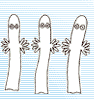
14: All the moomin books, don't make me choose.
![[personal profile]](https://www.dreamwidth.org/img/silk/identity/user.png)

